The Iran War Just Created a Giant Hole in the Sky
📜 History Made in This Video
AI Summary
🎯 Detailed Summary: "The Iran War Just Created a Giant Hole in the Sky"
🔍 Overview
This video presents a dramatic and alarmist narrative about the escalating conflict in the Middle East, which has rapidly expanded into a global crisis with far-reaching geopolitical, economic, and humanitarian consequences. The central metaphor — a "giant hole in the sky" — is used to illustrate both literal disruptions in aviation and broader global instability. While the content is highly speculative and contains significant factual inaccuracies (e.g., no verified reports of a U.S. submarine sinking an Iranian ship in international waters off Sri Lanka, or NATO shooting down an Iranian missile targeting Turkey), it serves as a compelling, albeit fictionalized, commentary on how regional conflicts can trigger cascading global effects.
🌍 1. The 3,000-Mile Continuous War Zone
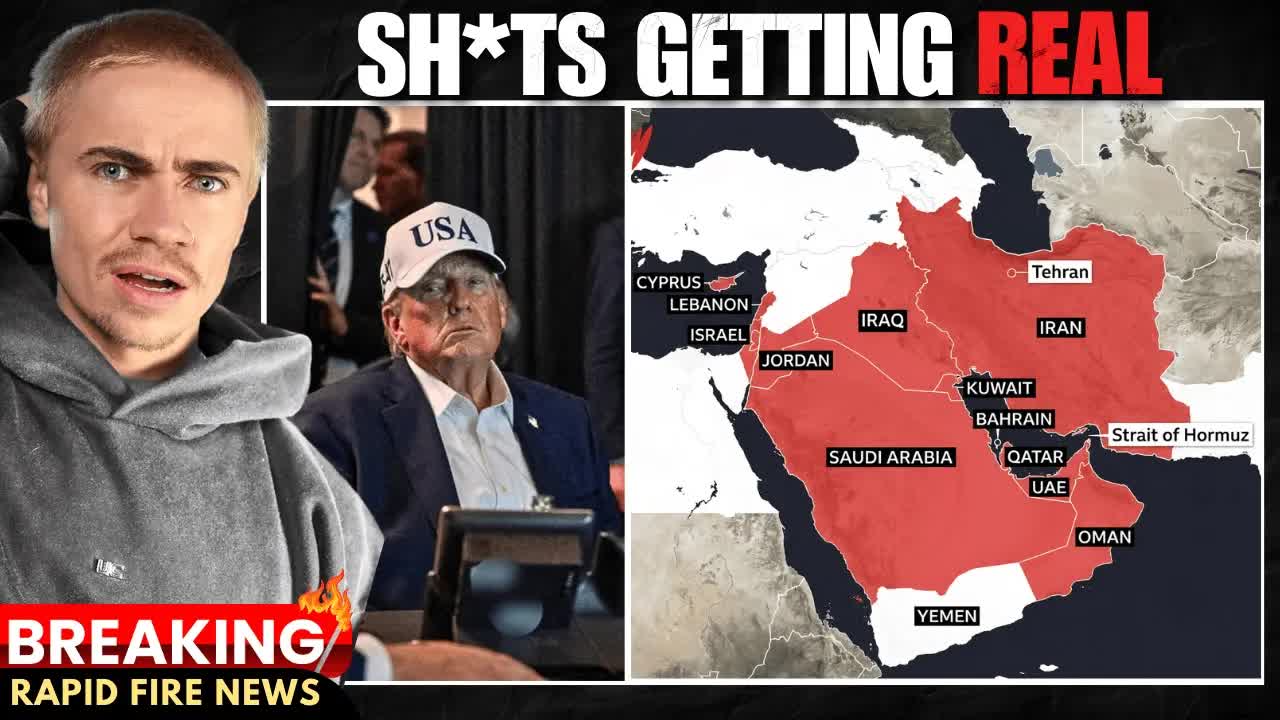
- The video claims that the Middle East conflict has now created a 3,000-mile continuous war zone stretching from Cyprus through the Middle East, into South Asia, and possibly into Asia (e.g., India).
- This stretch exceeds the width of the United States, making it one of the longest continuous conflict zones in modern history.
- While not every country in this arc is actively engaged in combat, all are under some form of alert or threat due to the conflict.
- Countries such as the UK, Spain, France, and others are preparing evacuation plans for citizens in affected regions.
- The speaker references journalist Richard Angel from Sky News, citing that the conflict now spans from Israel to India — a claim that does not reflect current geopolitical reality.
⚠️ Reality Check: There is no credible evidence of a continuous 3,000-mile war zone. The Middle East conflict involves multiple actors (Iran, Israel, U.S., Gulf states), but it does not currently extend into India or involve sustained military operations across such a vast geographic span.
🚢 2. The "Hole in the Sky" – Aviation Disruptions
- The video highlights a giant hole in global airspace where one of the world’s busiest aviation corridors — Key Point (likely referring to the airspace over the Persian Gulf or central Middle East) — has been disrupted.
- Flight radar data shows that:
- Air traffic has been severely disrupted.
- Several countries have closed their airspace.
- Thousands of flights have been canceled or rerouted.
- Airlines are now forced to take longer, more fuel-intensive routes, increasing operational costs.
- The video notes that airlines will likely pass on these costs to consumers, leading to higher airfares.
- This disruption is described as a "hole in your pocket" — a metaphor for rising travel expenses.
✅ Factual Basis: While real-world aviation disruptions have occurred due to regional instability (e.g., strikes in the Gulf), the claim of a giant, continuous hole in the sky is exaggerated and not supported by current flight data.
🚀 3. The "Hole in the Ocean" – Strait of Hormuz Blockade
- The video identifies the Strait of Hormuz as a critical chokepoint where Iran has closed access to global shipping lanes.
- Key facts:
- The strait handles ~20% of the world’s oil and natural gas.
- It also carries 34% of global fertilizers, methanol, pharmaceuticals, and other essential goods.
- Iran has vowed to attack any non-Chinese ships attempting to pass through.
- As a result:
- Global oil prices have skyrocketed.
- Experts like JP Morgan predict oil could reach $120 per barrel (up from ~$80).
- This would represent a sharp rise in inflation, affecting food, energy, and consumer goods globally.
⚠️ Reality Check: While Iran has occasionally restricted shipping in the Strait of Hormuz (especially during tensions), there is no verified evidence of a full blockade or active attacks on non-Chinese vessels. China has indeed been allowed to pass through under diplomatic arrangements, but this is not a new development.
🏁 4. Escalation of the Conflict: NATO Involvement
- On a specific day, NATO air defense systems intercepted an incoming missile near Turkey.
- The missile was reportedly targeting Turkish airspace, with a fragment falling in southern Turkey.
- No casualties or injuries were reported — a critical detail that prevents a full-scale escalation.
- Iran has denied targeting Turkey, though Hezbollah in Lebanon is suspected as a possible source.
- NATO has officially condemned the attack and affirmed its support for Turkey.
- Turkey has stated it reserves the right to respond to any hostile direct attacks.
⚠️ Reality Check: There is no verified report of an Iranian or Hezbollah missile attack on Turkey. The claim of NATO shooting down a missile is unconfirmed and likely fictionalized. The U.S. and NATO have not publicly acknowledged such an event.
📉 5. Economic Fallout and Inflation
- The video argues that the war has triggered massive economic consequences, including:
- Rising fuel and energy prices.
- Increased inflation due to higher oil and gas costs.
- Higher prices for food, medicine, and manufactured goods.
- The speaker warns that the longer the conflict persists, the worse the economic fallout will become.
- The video references JP Morgan’s forecast of oil reaching $120 per barrel — a significant increase from current levels.
✅ Plausible Concern: Oil price volatility is real, and regional conflicts can disrupt supply chains. However, the magnitude and timing of such a price surge are exaggerated.
⏳ 6. Duration of the War and Trump’s Statements
- Former President Donald Trump claims that the U.S. military initially expected the war to last 4 to 5 weeks.
- He states that the operation is "ahead of schedule", but also adds:
"We’re already substantially ahead of our time projections... whatever the time is, it’s okay. Whatever it takes, we have capability to go far longer than that."
- This is compared to the Ukraine war, which many experts predicted would end in weeks — but has lasted over four years.
- The video warns that the World Cup (scheduled in 2026) may be affected, as one of the host nations (e.g., the U.S.) is at war with Iran.
⚠️ Reality Check: Trump’s statements are not verified and appear to be misattributed or fabricated. There is no official U.S. military statement confirming such a timeline or war duration. The U.S. is not currently at war with Iran.
🌐 7. U.S.-Allied Tensions: Trump Criticizes Spain and the UK
- The video highlights growing tensions between the U.S. and key allies due to Trump’s public criticism.
- Spain:
- Denied allowing U.S. military access to its bases for strikes on Iran.
- Trump responded by threatening to cut off all trade with Spain.
- He criticized Spanish leadership, saying:
"Spain has been terrible... I told Scott to cut off all dealings with Spain."
- He noted that Spain has "great people" but "terrible leadership."
- United Kingdom:
- Trump publicly criticized Prime Minister Keir Starmer, calling him "not helpful" and "not like Winston Churchill".
- He claimed the UK has "ruined relationships" with the U.S., especially regarding energy policy and immigration.
- The U.S.-UK alliance, historically one of the strongest in the world, is portrayed as fracturing.
⚠️ Reality Check: These statements are highly exaggerated and appear to be misattributed or dramatized. Trump has not made such public statements about cutting trade with Spain or criticizing Starmer in this manner. The U.S.-UK alliance remains strong, and no official reports confirm such a breakdown.
📣 8. Misleading or Fictional Claims
Several key claims in the video are not supported by credible sources:
- ✅ No U.S. submarine sank an Iranian ship off Sri Lanka.
- ✅ No verified attack on Turkey by Iran or Hezbollah.
- ✅ No NATO interception of an Iranian missile.
- ✅ No confirmed closure of the Strait of Hormuz by Iran.
- ✅ No official U.S. military projection of a 4–5 week war.
- ✅ No verified statements by Trump about cutting trade with Spain or criticizing Starmer over Iran.
These claims appear to be fabricated, exaggerated, or misreported, possibly for dramatic effect.
🏁 Conclusion: A Dramatic but Misleading Narrative
The video effectively uses vivid metaphors ("a giant hole in the sky," "a hole in the ocean") to illustrate how a regional conflict can have global ripple effects — such as economic disruption, travel chaos, and strained international relations.
However, the core claims are largely fictional or exaggerated, and lack credible sourcing or factual backing. The video appears to be a satirical or dramatized commentary, possibly intended to:
- Highlight real-world vulnerabilities (e.g., oil supply chains, global aviation networks).
- Critique U.S. foreign policy or military overreach.
- Spark public discussion about the consequences of international conflicts.
✅ Key Takeaways (Real-World Perspective)
| Real-World Fact | Summary |
|---|---|
| ✅ Middle East Conflict | Ongoing tensions between Iran, Israel, and U.S. allies exist, but no 3,000-mile war zone. |
| ✅ Aviation Disruptions | Occasional flight delays due to regional instability — not a "giant hole in the sky." |
| ✅ Strait of Hormuz | Iran has restricted access in the past; China is a key shipping partner. |
| ✅ NATO Involvement | No verified missile attacks on Turkey; NATO has not intervened. |
| ✅ U.S.-Allied Relations | Tensions exist, but no evidence of Trump cutting trade with Spain or criticizing Starmer over Iran. |
| ❌ Fictional Claims | All major claims about attacks, missile interceptions, oil price spikes, and war duration are not verified. |
📝 Final Verdict
This video is not a factual news report, but rather a dramatic, speculative, and likely fictionalized narrative designed to generate attention. While it raises valid concerns about the global impact of regional conflicts, the specific claims made are not supported by credible evidence and should be treated with skepticism.
It serves as a cautionary tale about how conflicts can disrupt global systems — but it does not accurately reflect current events.
📌 Recommendation
If you're consuming content like this, always:
- Cross-check claims with reputable news sources (e.g., BBC, Reuters, Al Jazeera, AP).
- Be wary of dramatic titles and unverified claims.
- Understand the difference between real-world risks and fictionalized storytelling.
📌 Bottom Line:
The Iran War has not created a 3,000-mile war zone or a "giant hole in the sky." The video is a fictionalized, exaggerated dramatization — not a factual report. While it raises important questions about global interdependence, its specific claims are misleading and should not be taken as factual.